§ COUNTER-SWARM THE INTELLIGENCE LAYER PHASE I · 2026
IN DEVELOPMENT

The swarm is
a software
problem.

Coordinated drone swarms defeat defenses built to handle one target at a time. The answer is not a better sensor or a bigger interceptor — it is a distributed brain that can see, classify, and prioritize fifty targets at once, at the edge, with a human on the loop.

Tracks50+ simultaneous
DecisionsAt the edge · ms
§ 01 The threat has changed Mass, not machines

Swarms are the defining airspace threat of this decade.

The numbers from current conflicts are not edge cases — they are the new baseline. Defense that assumes one inbound at a time is already obsolete.

One day · June 2026
927

Drones Russia claims to have intercepted in a single day — the largest coordinated aerial attack on record.

One raid · Gulf conflict
689

Iranian drones tracked by the UAE in a single campaign; 645 intercepted — at a pace no interceptor inventory sustains.

RF-silent share
10–30%

Reported share of frontline drone production using fiber-optic guidance — zero RF signature, invisible to RF-only detection.

CNAS · SEPTEMBER 2025 “After decades of air dominance and a near monopoly on precision strike, the United States now faces a dramatically different, more hostile world as the proliferation of cheap drones has democratized mass precision fires.” — Countering the Swarm, Center for a New American Security
§ 02 Why current systems fail Structural, not incremental

Four failure modes no faster sensor can fix.

Every fielded counter-UAS system was designed for a different problem: one drone, one operator, one decision at a time. Against a coordinated swarm, the architecture itself is the bottleneck.

01Sensing

The RF blind spot.

RF-based detection assumes a radio link to intercept. Autonomous and fiber-optic drones don't have one — a swarm of RF-silent aircraft is invisible to every RF-only system on the market.

02Jamming

Nobody's listening.

Jamming disrupts a control link. A pre-programmed autonomous swarm carries its mission onboard and executes without external input. The entire electronic-warfare layer offers no protection — you have to see it instead.

03Architecture

The single-point ceiling.

One radar, one operator station, one decision-maker: fine for two targets, impossible for fifty arriving from multiple azimuths. A single node cannot see a three-dimensional swarm, let alone prioritize it.

04Latency

The cloud is too far away.

A 50-drone swarm from 3 km out gives you roughly 100 seconds — about two seconds per target. Systems that round-trip to a cloud for classification are saturated before their first decision lands.

§ 03 — THE INSIGHT Stopping a swarm is not a sensing problem, and it is not a shooting problem. It is an intelligence problem — and the Pentagon agrees: its $100M Orchestrator Prize Challenge is explicitly a search for the brain, not another sensor or shooter.
§ 04 The answer A mesh with a brain

Match a distributed threat with a distributed defense.

The Neura Canopy is a mesh of autonomous sensor stations, each running the full Neurex intelligence stack at the edge. No single point of failure. No cloud round-trip. No target unaccounted for.
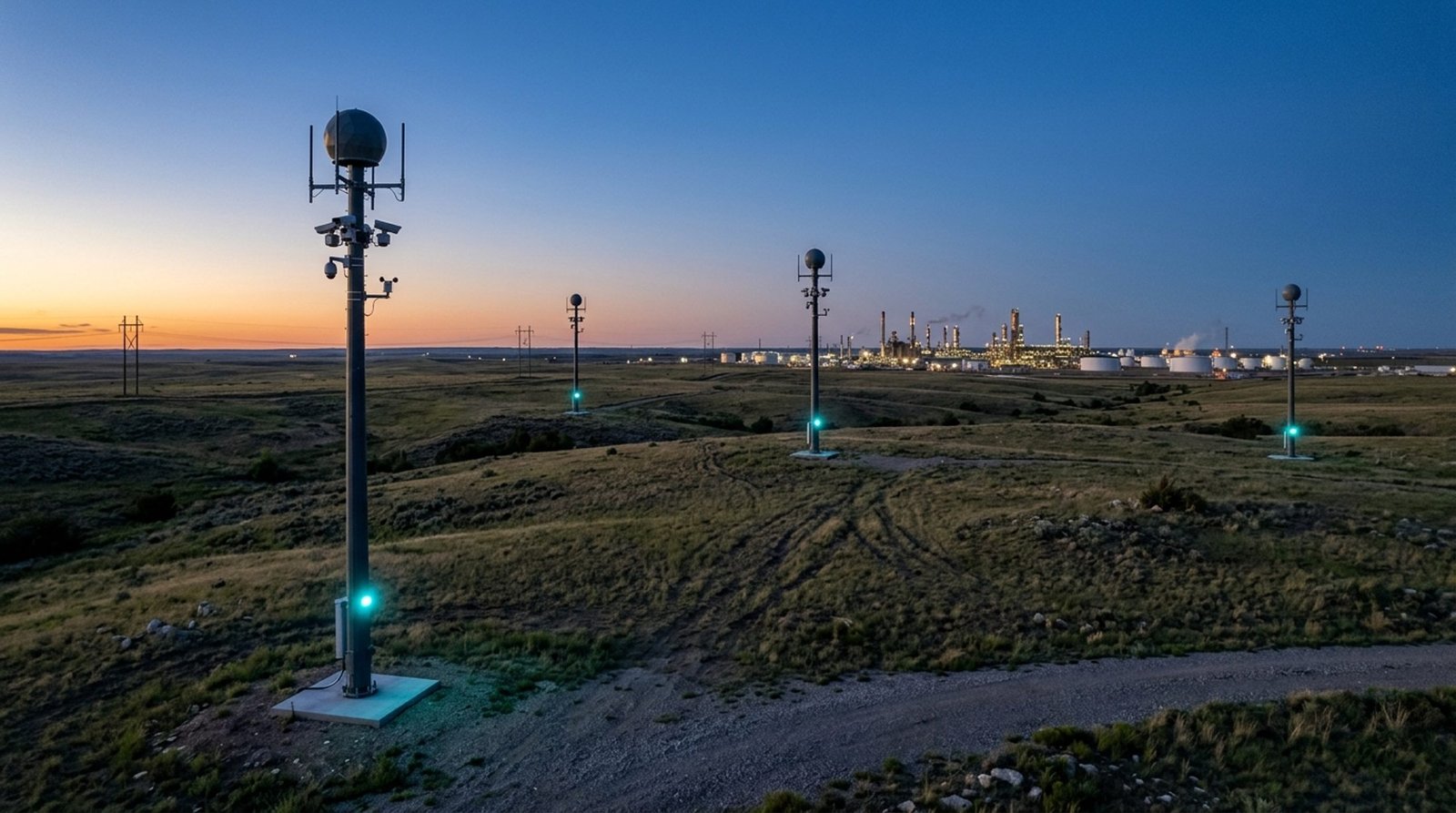
Neura Station mesh perimeter protecting an industrial facility at dusk
01See

Seven ways of seeing.

Acoustic, RF, radar, electro-optical, infrared, LiDAR, and neuromorphic event vision on every station. Each modality covers the others' blind spots — an RF-silent drone is still loud, warm, and physically present.

02Reason

Knows what it doesn't know.

Neurex fuses sensors with Dempster-Shafer evidential reasoning — belief, disbelief, and explicit uncertainty. Instead of a mystery "55% threat," the operator sees "40% armed, 15% decoy, 45% uncertain — observing from Node C."

03Decide

Milliseconds, at the edge.

Every station runs full inference locally on edge AI hardware. Detection, classification, and prioritization happen at the node. Cut the network and every node keeps working — there is no link to sever.

04Coordinate

The swarm as one entity.

The Canopy distributes tracking across nodes and understands formations — scouts, main body, reserve wave, decoys — then cues the operator with priorities, not just tracks. A human authorizes; the mesh executes the watching.

EVERY ENCOUNTER, EVERYWHERE Federated learning shares model updates — never raw data — across deployments. A new swarm tactic seen at one site makes every site smarter, without operational data leaving its enclave.
The technology
§ 05 Scaling 10 → 1,000 targets

Three orders of magnitude, one architecture.

Because every station carries its own intelligence, adding nodes adds capacity linearly. Coverage scales by deployment, not redesign.

Threat scaleDeploymentArchitecture response
10 drones · raid2–4 stationsSingle Canopy cluster; each node tracks 3–5 targets
50 drones · swarm4–8 stationsDistributed tracking and cueing across the mesh
100 drones · mass attack8–16 stationsSector-based responsibility with inter-sector handoffs
1,000 drones · saturation16–40+ stationsFederated multi-Canopy coordination by sector
§ 06 One hundred seconds A swarm raid, walked through

Fifty inbound. Here's what the Canopy does.

A 50-drone raid against a facility protected by a six-station Canopy — detection through decision, with the human in command throughout.

T−180sDetect

Three modalities, three nodes, two seconds.

Acoustic arrays, radar, and neuromorphic vision establish tracks on 47 of 50 targets. The three hidden in terrain shadow are flagged — with explicit uncertainty scores, not silence.

T−150sClassify

Decoys exposed, threats ranked.

EO/IR classifies the swarm: 8 likely decoys, 32 probable attack profiles, 7 ambiguous. The ambiguous seven get more observation tasked automatically — not a guess.

T−120sPrioritize

One plan, one authorization.

Neurex presents a ranked engagement plan to the operator — priorities, confidence, recommended allocation. The human authorizes with a single confirmation. Machine speed, human judgment.

T−90sCue

Cueing flows to the countermeasures operators already field.

Precise coordinates, vectors, and priorities stream to partner response systems in real time. As the swarm maneuvers or splits, the Canopy redistributes tracking — and the audit trail records every decision.

STATUS · PHASE I · 2026 The counter-swarm capability described here is in active development: sensor fusion and the Neurex decision engine are being built on edge AI hardware now; Canopy mesh coordination and federated learning are architecture-defined. Our posture is detection and cueing first — effects are delivered via partner systems, with response integration available under program review with qualified customers.
The platform
Next

The swarm is coming. The defense should be ready.

We're building the intelligence layer for swarm defense — and working with defense partners, integrators, and investors who see the same problem.